 |
|
 |
FIRST TRIAL ORDER KIT roducts & Effects |
 |
|
 |
|
FIRST TRIAL ORDER KIT ( 3 OPTIONS: A, B, C)
|
Option A: 1 formulation: 1 × 200 g container
Option B: 2 formulations: 2 × 100 g containers (Currently upgraded to 2 × 100 g)
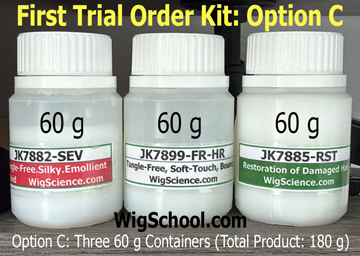
Option C: 3 formulations: 3 × 60 g containers (as shown in the photo at left) 
Option D: 4 formulations: 4 × 35 g containers
|
|
|
 |
 |
 |
200 ml Bottle |
100 ml Bottle
|
1 Liter Bottle |
This 200 ml bottle is typically used to fill
approximately 200 g of JK-HairCoat product,
depending on formulation density. |
This 100 ml bottle is typically used to fill
100 ml, 80 mn, 50 ml for a Trail Sample Kit |
This 1 liter container is typically used to fill
approximately 1 kg of JK-HairCoat product,
depending on formulation density. |
| |
|

|
|
|
|
|
 FEATURES |
JK-HairCoat is formulated with high-grade cosmetic raw materials,
engineered to be safe for both the environment and the human body.
|
| STORAGE |
Store JK-HairCoat in a cool, shaded place (5–25°C),
away from direct sunlight, following standard chemical storage practices. |
| SHELF LIFE |
Minimum shelf life of 3-5 years when stored under recommended conditions.
|
| PACKAGE UNIT |
Mimimum Package Unit (MOQ): 200 g.
For shipping safety, bulk packaging is available in strong plastic containers of 0.5 kg, 1 kg, 2 kg, 5 kg, and 10 kg (10 liters). |
| APPLICATION |
Application instructions are simple. Please contact us for detailed guidance. |
|
|
99.99% of hair goods available on the market are treated with wig oils or silicone-based industrial oils to create a silky, soft,
wet, or healthy-looking appearance.
However, these wig oils are not permanent and are removed after one wash, or a few washes at most—similar to makeup being washed off the face.
Moreover, wig oils do not restore damaged hair.
In contrast, our Permanent John-HairCoat products provide long-lasting effects because they are ionically bonded to
human hair and synthetic fibers, forming a unified structure.
Within seconds after applying the HairCoat conditioner mixture by spraying, the permanent hair coating process is completed.
Immediately after application, the hair can be washed, shampooed, rinsed, permed, or otherwise processed.
RETENTIVENESS (DURABILITY) OF JOHN-HAIRCOATS
The hair coating effects—such as silky look, wet look, detangling, and damage protection—are retained for approximately
3 to 6 months, or even after dozens of washes. |

 |
 |
|
| |
 |
|
| |
|
|
 |
Question-1
: With 200 ml of JK-HairCoat, how many kilograms of hair can be treated or processed? |
|
 |
Approximately 66 kg of human hair.
Using our standard dipping method:
-
3 g of JK-HairCoat can treat approximately 1 kg of hair.
-
200 g of JK-HairCoat can treat approximately 66 kg of hair.
-
1 kg of JK-HairCoat can treat approximately 333 kg of hair.

For example, with just 3 g of JK-HairCoat, you can treat:
-
5 wigs, each containing approximately 200 g of hair.
-
10 hair extensions or wefts, each weighing approximately 100 g.
Simply mix 3 g of JK-HairCoat with 1 liter of water (approximately 40°C) and treat the hair using the dipping method.
Note: These are general estimates. Actual consumption may vary depending on hair type, condition, and application method. |
|
| |
|
Would I be able to add a drop to a spray bottle and use it as a leave in conditioner
or is that process completely different and it has to be done like your YouTube video ? |
|
|
Yes, certainly.
You may also try one formulation for synthetic hair, so your Sample Kit can include three different formulations:
For your first order only, I can make a special exception and offer you a Sample Kit containing three different formulations.
Instead of receiving one 200 g product in a 200 mL bottle, you may choose three different formulations, each containing 60 g in a 100 mL bottle.
++
Regarding your second question, yes, spraying is also one of the recommended application methods.
The dipping method shown in my YouTube video is only one application method. Depending on the quantity of hair, the type of product, and the purpose of the treatment, I also recommend spraying, submerging, and several other application methods.
For spraying, the formulation is normally diluted with water. However, the dilution ratio (1 : 100) is usually higher than (3-5:1000) for dipping, because some of the solution is inevitably lost during spraying.
So yes, you can prepare a spray bottle and use it as a leave-in treatment. The important point is not the application method itself, but applying the correct amount of JK-HairCoat as evenly as possible over the hair.
I will also provide the recommended dilution ratios and application methods for each type of hair after your purchase. |
|
| |
|
|
|
Q1. Does
John's HairCoats obstruct color dye in dyeing human hair wefts ? |
|
|
A thin film (membrane layer) formed by HairCoat may slightly affect dye penetration. |
|
| |
However, when dyeing is performed with water at a high temperature, HairCoat does not significantly interfere with the dyeing process.
Hair dyes in salons can generally penetrate the HairCoat membrane without major difficulty.
In addition, when the hair is washed with water—preferably hot water—the microscopic pores in the JK-HairCoat membrane temporarily expand, allowing hair dye to pass through the membrane and reach the hair cuticle. |
|
Q2. After Iron-hair
straightening, will the effect last ?
|
|
|
Yes. The effects of JK-HairCoats remain after hair straightening with a flat iron. |
|
|
Q3. Does
the JK-HairCoats damage the thread of wefts or affect hair color ? |
|
|
No. John’s JK-HairCoat causes no change to the strength or quality of the sewing thread, and it does not affect the color of the hair. |
|
|
{Question} I need your coating
anti tangle product for cuticle hair. |
|
{Answer} I can recommend JK7881-SoSi,
JK7882-SEV, JK7885-RST, JK7888-SHN, JK7889-EmC.
All haircoats are anti tangle products for
cuticle hair. Please view the List 1, the web page of . |
|
What is the shelf life of JK-HairCoat? |
|
Shelf Life : Up to 3 years unopened, and about 12 months after opening under proper storage conditions. |
|
Subject : JK-HairCoat™ Spray Application April 4, 2026
{Question} I remember seeing on your website that some people put the hair coat solution into a spray bottle and they spray it on the wig to help to detangle it. Does the solution have to be freshly mixed and still hot? Or can a small batch of the solution be made and last for a few days in a small spray bottle? |
|
{Answer}Yes, JK-HairCoat™ can be used in a spray bottle for light application, such as detangling or surface conditioning.
The solution does not need to be hot, and it is not necessary to use it immediately after mixing.
You may prepare a small batch in advance and keep it in a spray bottle for a few days, provided that:
- It is stored at room temperature
- The container is clean and properly closed
- The solution is not contaminated during use
However, for best performance, we recommend using a freshly prepared solution whenever possible.
Also, please note:
Spray application may result in some loss of solution into the air, so a slightly higher concentration (compared to dipping method) can be helpful.
If you need, I can also suggest an appropriate mixing ratio for spray use.
Best regards, |
| |
|
|
How should JK-HairCoat be stored? |
|
JK-HairCoat should be stored under the following conditions:
- Keep in a cool and dry place
- Avoid direct sunlight
- Store at room temperature (recommended: 5°C–25°C / 41°F–77°F), following standard storage conditions for most chemicals and pharmaceuticals.
Based on our experience, the product remains stable under normal indoor conditions over extended periods.
- Keep the container tightly closed
- Avoid exposure to extreme heat or freezing temperatures
|
|
Could you please provide a little more information about the condition of the blonde hair?
-
When you gently pull the hair strand, does it stretch slightly and return, or does it break immediately?
-
When you run your fingers along the hair from root to tip, does it feel relatively smooth, or does it feel very rough and resistant?
-
When the hair is wet, does it become very sticky or gummy, or does it remain relatively firm?
-
When you comb the hair, does it tangle easily, or does it remain manageable?
-
Under light, does the hair appear dull, or does it still show some natural shine?
These observations will help me better understand the actual condition of the cuticle and the internal keratin structure of the hair. |
|
|
|
Please get informed I have been with you while I have not texted you because your questions and words had (?) me to think a lot and say a lot to you.
So, it took time for me to write into English.
Most toupee and wig factories worldwide, as well as most human hair processing and coloring factories, do not use JK-HairCoat.
The main reasons are historical and structural.
First, 40–50 years ago, in Korea (1970s) and later in China (since the 1990s),
technicians who processed and colored raw human hair used industrial silicone oils, simply because there were no alternatives available at that time.
Younger technicians have continued to follow the same methods, learning directly from senior technicians, and this practice largely remains unchanged today.
Even now, many factories in China, India, Indonesia, Vietnam, African countries, Russia, and other regions continue to condition hair using low-cost industrial silicone oils, following traditional methods.
In the past, industrial silicone oil was the only option.
Today, JK-HairCoat exists, but for large-scale wig and hair processing factories, especially in low-wage manufacturing countries, JK-HairCoat is considered too expensive for mass production.
Additionally, most factories are not even aware of the existence of JK-HairCoat.
However, the situation is completely different in the end-consumer market, not the manufacturing market.
In developed, high-wage countries such as the USA and Europe, the retail prices of human hair wigs and extensions are very high.
Considering the function and performance of JK-HairCoat, it is not expensive for end consumers or shop owners in these markets.
More importantly, JK-HairCoat creates an effect strong enough that customers are willing to return for re-conditioning every 1, 3, or 6 months, which is commercially very important.
With conventional industrial silicone oils, the coating effect—such as a silky look and silky touch—disappears after one or two washes.
In contrast, JK-HairCoat remains effective after dozens of washes, although durability varies depending on usage conditions such as wearing frequency, environment, and maintenance.
In hot or harsh environments, hair may dry out faster or the cuticle may become damaged.
In such cases, JK-HairCoat does not disappear by itself; rather, when the cuticle layer is lost, the coating attached to it is lost together.
Even so, this behavior is fundamentally different from industrial silicone oils, which lose their effect after just one or two washes. |
|
|
| |
 |
|
Remy Hair, Non-Remy Hair, and the Role of JK-HairCoat
Remy Hair
Remy Hair consists of hair fibers whose cuticles are aligned in the same direction, from root to tip.
Because all hair strands follow a uniform cuticle direction, friction between neighboring fibers is minimized. As a result, Remy Hair generally provides:
- Better combability
- Reduced tangling
- Improved softness
- Greater natural movement
- Longer service life
- More natural appearance
When JK-HairCoat is applied to quality Remy Hair, it can further enhance:
- Soft touch
- Silk-like touch
- Silk-like appearance
- Smoothness
- Slip and combability
- Tangle resistance
- Overall manageability
The ionic coating formed by JK-HairCoat can remain effective through numerous wash cycles and help maintain these desirable hair characteristics for an extended period.
Non-Remy Hair
In contrast, Non-Remy Hair contains hair fibers with mixed cuticle directions.
When neighboring fibers have opposing cuticle directions, the cuticle scales may interlock with one another, creating friction, matting, and tangling.
This structural characteristic is one of the major causes of tangling problems commonly associated with Non-Remy Hair.
JK-HairCoat does not change or correct the mixed cuticle directions that are inherent in Non-Remy Hair.
Therefore, JK-HairCoat alone cannot fundamentally solve tangling problems caused by mixed cuticle directions.
Some improvement may still be achieved when the cuticle scales are relatively flat and smooth rather than rough, lifted, or protruding.
In such cases, JK-HairCoat may help reduce surface friction and improve manageability to a certain extent.
The Most Effective Solution for Non-Remy Hair
For a fundamental improvement of tangling problems, the most effective approach is to first perform
a professional Tangle-Removal Treatment and then apply JK-HairCoat.
Tangle-Removal Treatment is a specialized technique designed to address the root causes of tangling associated with Non-Remy Hair.
When properly performed, it can significantly improve the hair structure and transform highly tangled Non-Remy Hair into a much more manageable condition.
After the Tangle-Removal Treatment, JK-HairCoat can further enhance:
- Tangle resistance
- Soft touch
- Silk-like touch
- Silk-like appearance
- Smoothness
- Combability
- Manageability
Depending on the condition of the hair, maintenance practices, and washing methods, these benefits may remain noticeable for 3–6 months
or even after dozens of washes.
Training Program
John Korea Co. provides specialized training in professional Tangle-Removal Treatment technology through:
- Online Training
- Hands-On Training
Training Fee: US$3,000.00 |
|
